Click here for previous chapters
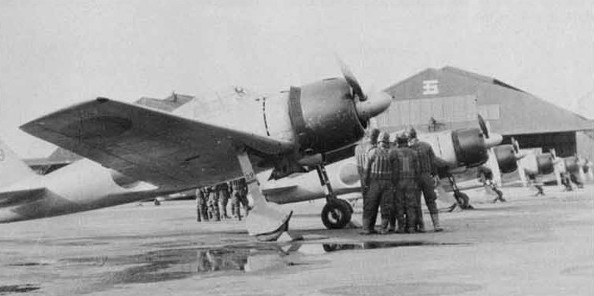
It was around this time that my glide training began in the Zero.
Training began by taking the Zero up to 400 meters, pulling the throttle to idle and gliding on the proper approach path, gear up to a pre-selected point. For a seaplane pilot like myself this was very easy.
After successfully gliding from 400 meters, the same thing was done from 1,000 meters, then from 2,000 meters. Only after passing those tests did we make our first flights in the K-1. This was called ‘drop training.’

This was during winter, the coldest time of year. There was frost on the ground and the temperatures at altitude were well below freezing. When descending steeply from high altitude with the throttle pulled back it’s very easy to damage the engine through ‘shock cooling.’ To prevent that it was important to close the cowl flaps prior to starting our descent. If the pilot forgot, not only would the Zero fail to attain the desired airspeed, the cowl flaps would resonate so violently that they’d get bent out of shape and wouldn’t close again.
Right down in the weeds
Once we could confidently glide down from 2,000 meters we moved to the second airfield to practice approaches to landing. During this training we wouldn’t actually land. Instead, we’d bring the plane down ‘till we were right down in the weeds and check out the landing area, looking for potential problem areas. This ‘crazy training,’ as we called it, was done to prepare us for successful actual landings in the K-1.
Prior to relocating the training to Kōnoiké there’d been a fatal K-1 crash at Hyakurigahara Airfield during a test flight. Thereafter water ballast was no longer carried and metal ballast was used. Regardless, we all had to learn the K-1’s flying characteristics for ourselves. And this began by each of us strapping into a K-1 and doing one drop from a bomber at high altitude.
Those pilots who were furthest along on their training were the first to go. These were for the most part veteran pilots.
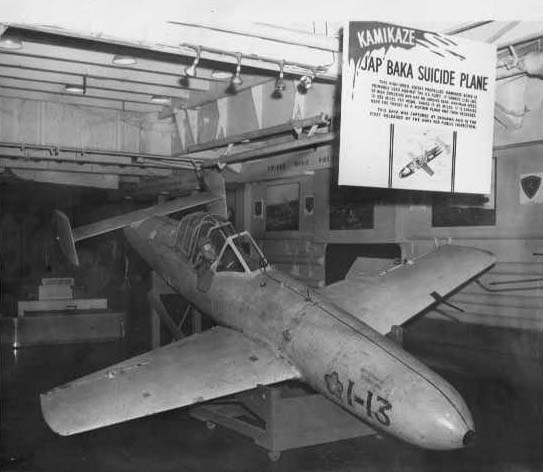
The training K-1s had their warheads replaced with a piece of steel of the same weight in the shape of an artillery shell. This ensured the same flight characteristics as an armed K-1. Without the rocket propulsion of the combat units, the wings could only generate lift by gliding fast. In other words, the thing would only fly if it was descending very rapidly. No landing wheels were fitted, the K-1 touching down on an arched wooden skid instead. Metal skids were also attached to each wingtip.
The secondary airfield
The main airfield was used exclusively by the bombers. The K-1s landed at the secondary airfield located about 2 km. south. And it was an airfield in the truest sense of the word, as it was merely a levelled dirt field overgrown with grass.

The grass was mostly shoulder high, but at the field’s midpoint the landing surface consisted of sand and stubby grass. The field was located adjacent to the Toné River where it bends northward. It was a narrow field and was approximately 2,200 meters long. To the field’s left and right — that is, to its east and west — the ground was rough and uneven and covered with mounds of sand and there was also a pine forest. A landing in that area would end badly for both pilot and K-1.
Northwest of this area was the Navy’s weapons testing area. Prior to the start of the war, they set up armour plates in the actual size of one of the American battleships in Hawaii to test the effectiveness of their armour piercing bombs. The tests were used to determine the minimum altitude from which the bombs could pierce the armour.
Viewed from above, there was a large white circular mark in which were the scattered remains of a Type 96 dive bomber. The command centre for this grassy field was located at its north end.

About three months left to live
One evening, as the day for our drop training approached, I was sitting at the table in our barracks after dinner when I noticed a pilot sitting by himself writing something.
“Can’t sleep, eh?”
He looked over at me with a deeply crestfallen expression and when I looked in his eyes I saw the look of a man facing imminent death. His expression moved me profoundly. And in fact, he probably only had about three months left to live. The same could also be said about me.
Yes, I thought. Someone said you can’t write letters or describe your emotions after you’re dead. That’s what he’s doing. And that’s what I should do. I’ll record my own experiences at this squadron where I too am living on borrowed time. I’ll leave my account with my personal effects for others to read.
Suddenly inspired, I began to keep a diary of my experiences after arriving at the Jinrai Butai.

Into the quiet night
One evening as I was writing my diary I heard someone softly playing a mandolin in our sleeping area. The melancholy melody made me suddenly homesick.
Our barracks were crowded, dark and cold, the thin floorboards covered only with threadbare blankets. Although each of us were issued three blankets, the nights were so cold that we couldn’t sleep, so we often combined our blankets and slept two to a bunk for added warmth.
A single bulb hung forlornly from the ceiling. Shaded with a black cloth due the blackout, only in the small cone of light directly beneath it was there enough light to see. Aside from some light snoring and the occasional shuffling of a mound of blankets it was very quiet.
It was below this light that someone was expressing their loneliness on a mandolin, the solitary notes floating out into the quiet night. One other person was also awake. He was gazing intently at Flight Seaman Saburo Nakajima who was playing the instrument. He must’ve been one of his good friends.
Tornado Mountain
During this period the B-29s were carrying out their almost daily raids on the Kanto region. When the air raid sirens sounded we’d leave our barracks and take refuge on a small hill in a pine forest west of the field. From there we had an expansive view of the triangular shaped main airfield. A temporary command centre for the fighters was also located there. The hill had the strange name of Tatsumaki Yama (Tornado Mountain), but I never learned why.

The main gate to our base was located on the southern slope of this hill. Through it passed the road to the base, a road barely wide enough for a single truck.
After passing through the gate a road to the right led to the airfield, next to which was a parking garage. Further along was a hill called Gun-Battery Mountain and on which was mounted a 25mm antiaircraft gun. Below this emplacement was our maintenance hangar, and just beyond it the end of a runway, a bright white 80’ wide strip stretching off into the distance. The main runway, the one from which the bombers carrying the K-1s took off, was oriented on a north/south axis.
We often watched the B-29s from this hill, their contrails standing out clearly in the crystalline winter air, their formations sparkling beautifully in the sun. They didn’t fly over our field but passed by a short distance to the north.

NEXT TIME: A gathering of elite combat units >
These extracts are from the diary of Masa’aki Saeki, trainee Yokosuka MXY-7/K-1 Ohka pilot, 721st Kōkūtai Jinrai Butai, Imperial Japanese Navy.
Translated by Nicholas Voge and shared with permission.
Nicholas Voge is a retired Pt. 135 airline pilot who spent his younger years living in Japan where he worked as a translator, copywriter and riding model for the Japanese motorcycle manufacturers. His translations include The Miraculous Torpedo Squadron, The Inn of the Divine Wind and Kaiten Special Attack Group, A Story of Stolen Youth.
 airscape Magazine