

Nearly 2,700 nautical miles into its 3,220-mile mission (4,987km out of 5,965km) the USAF B-29 was in serious trouble.
Having fought cold and dirty weather all the way across the Bering Sea, it was low on fuel, and even lower on de-icing fluid. Below, the cold black sea was only marginally less inviting than the featureless white coast along the northern horizon.
The nearest glimmer of hope was the remote radio relay station and recovery airstrip at Moses Point, Alaska. At least there were people and shelter there. That and 4,700 feet (1,432m) of gravel, rolled flat for just such an occasion.
As the aircraft dragged itself towards an emergency landing, a new Air Force recruit barely into his first posting – to Elmendorf Air Force Base at Anchorage – would soon find himself heading to Moses Point too.

Not the Army
Robert Liggett was used to much warmer conditions. Born and raised in Tennessee, he had turned 18 in July of 1950, less than a month after the Korean War had broken out. Although no-one knew the conflict would rage up and down the Korean Peninsula for another three years, at the time the Chinese-backed North was very much ascendant and a major confrontation between the US and either communist China or its Soviet guarantors was a very real possibility.
What all that meant, in the Tennessee summer, was that Robert Liggett and several of his 18-year-old friends were holding extremely eligible draft cards.
Robert and a friend decided that, rather than having the US Army tell them where in Korea to dig a foxhole, they would choose the nature of their service first. So they went to the Air Force recruiting office together on 7 December 1950 – just the ninth anniversary of Japan’s attacks on Pearl Harbor – and enlisted.
When I asked him, Robert said he never joined the Air Force for the chance to fly. He had model aircraft as a boy (like most every American kid in the 1940s, I suspect), and remembers his Aunt in New York City sending him a balsa kit for his 8th birthday. He made several attempts to build his own wood models from sticks after that but, as he got through his teens, his main interest was motorbikes.
And not being in the Army.

Into the ice
Then, as now, new USAF recruits were sent to Lackland AFB in San Antonio TX for basic training. Robert was no exception and spent four weeks at Lackland. From there, he went to Selma AFB in Alabama for further training and emerged as an Airman – Heavy Equipment Operator with orders to report to Alaskan Air Command at Elmendorf AFB, outside of Anchorage.
While not as cold as Korea, and arguably heading into its warmer season, Alaska is a long way north of Tennessee, Texas or Alabama. April temperatures rarely stray out of single figures on the Celsius scale (mid-40s for Farenheiters).
But if Robert wasn’t cold enough yet, that wouldn’t matter. The Air Force was about to send him further north, for a rendezvous with that desperate B-29.
Ptarmigan bombers
Superfortress #4487744 was built by Boeing Wichita as a B-29-90-BW in 1945 and was upgraded to the weather reconnaissance WB-29 standard during 1950, with the fitment of Curtiss-Electric propeller reversers, removal of all defensive and bombing equipment, installation of a 640-gallon fuel tank in the bomb bay, and the addition of an air sampling “bug catcher” where the aft upper turret had been.
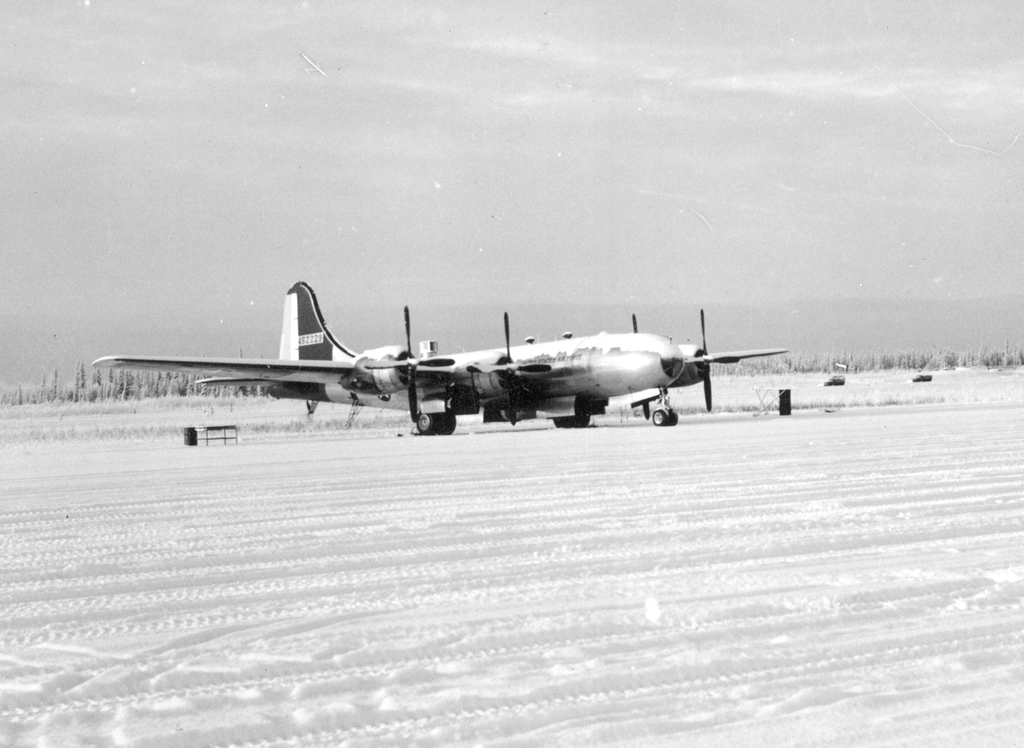
The Alaskan WB-29s were operated by the 58th Weather Reconnaissance Squadron, and flew daily ‘Ptarmigan’ mission between Eielson AFB near Fairbanks and Yokota Air Base in Japan. Nominally these were just weather observation trips but, in reality, they were also cover for top secret atmospheric sampling missions to detect traces of Soviet atom bomb tests. The ‘bug catchers’ collected particles from the air in paper or cloth filters, which were removed and tested at the end of each flight.
You can read more about this extremely successful exercise in A Real Lady, my article on the derelict WB-29 at Eielson that detected the first Soviet atom bomb test during a Ptarmigan flight in September 1949.

Isolated landing
While overall reliability was improved by the WB-29 upgrades, the four engined reconnaissance bombers were ageing aircraft, worked hard.
#4487744 had been damaged in an accident at Eielson the previous year. This is only described as a ‘weather landing’ on 9 March 1951. There is no record of damage and, given the similar time of year, I can only assume it involved ploughing off of a snow-covered runway.
Now, with everything running low, she’d need all eight of her remaining lives.
As the desperate aircraft slumped onto the narrow runway at Moses Point, one of its main gear sets dragged through a snowbank and spun the aircraft into the heavy drifts. In matter of seconds, what could have been a miracle landing became a four engined obstacle with a broken back, blocking a badly needed emergency strip.

The radio operators who were stationed at Moses Point passed the word back to Elmendorf and before long, six members of the 39th Aircraft Repair Squadron – including Robert Liggett – had orders to deploy north, move the aircraft and recover anything valuable. With no other facilities available, they would billet with the radio station crew and their families.
Robert had only been in Alaska a couple of weeks. The B-29 crashed on 8 April 1952, and the men of the 39th Acft. Rep. Sqn. departed Elmendorf on the 14th.

Wrenches and one crane
The B-29 had broken its back right at the main wing spar. The most valuable items on the wreck were the four engines. But first, the crew had to remove the nose section. Blocks (or, more likely, a few ubiquitous 44-gallon oil drums) were placed under the tail bumper so the aft section of the fuselage rocked back into a level attitude when the nose was cut free.
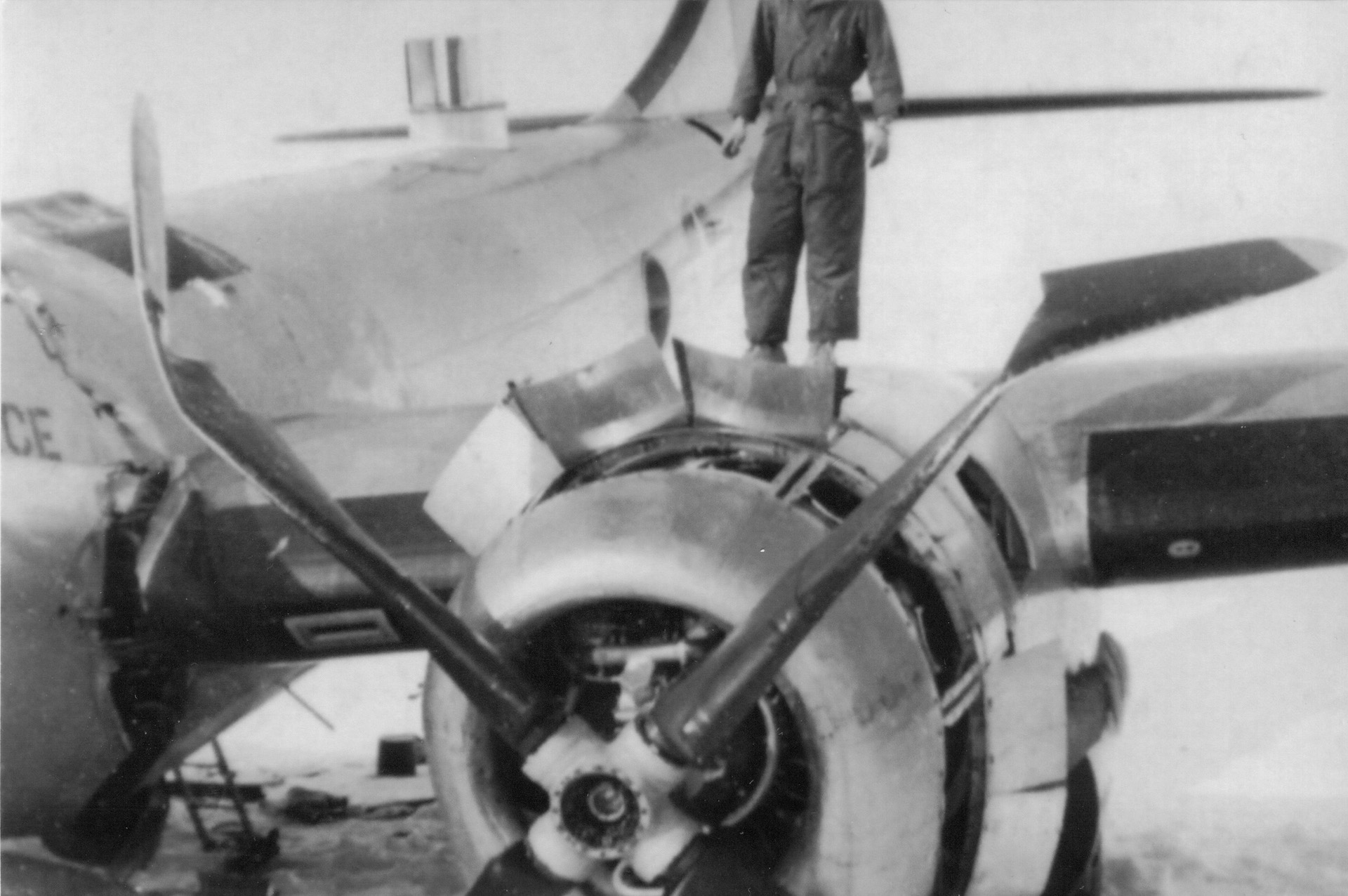


After that, the recovery crew men got to work with hand wrenches and a simple crane that was based on site. After three weeks and a lot of hard work, they had removed the tangled propeller blades and the power plants were lined up beside the runway, ready to be airlifted south.
However, as far as the US was concerned, “valuable” also included the top secret (and potentially radioactive) bug catcher. The Master Sergeant in charge assigned that task to the new guy – Robert Liggett. He was handed a fire axe and told to destroy then burn the sensitive air sampler.
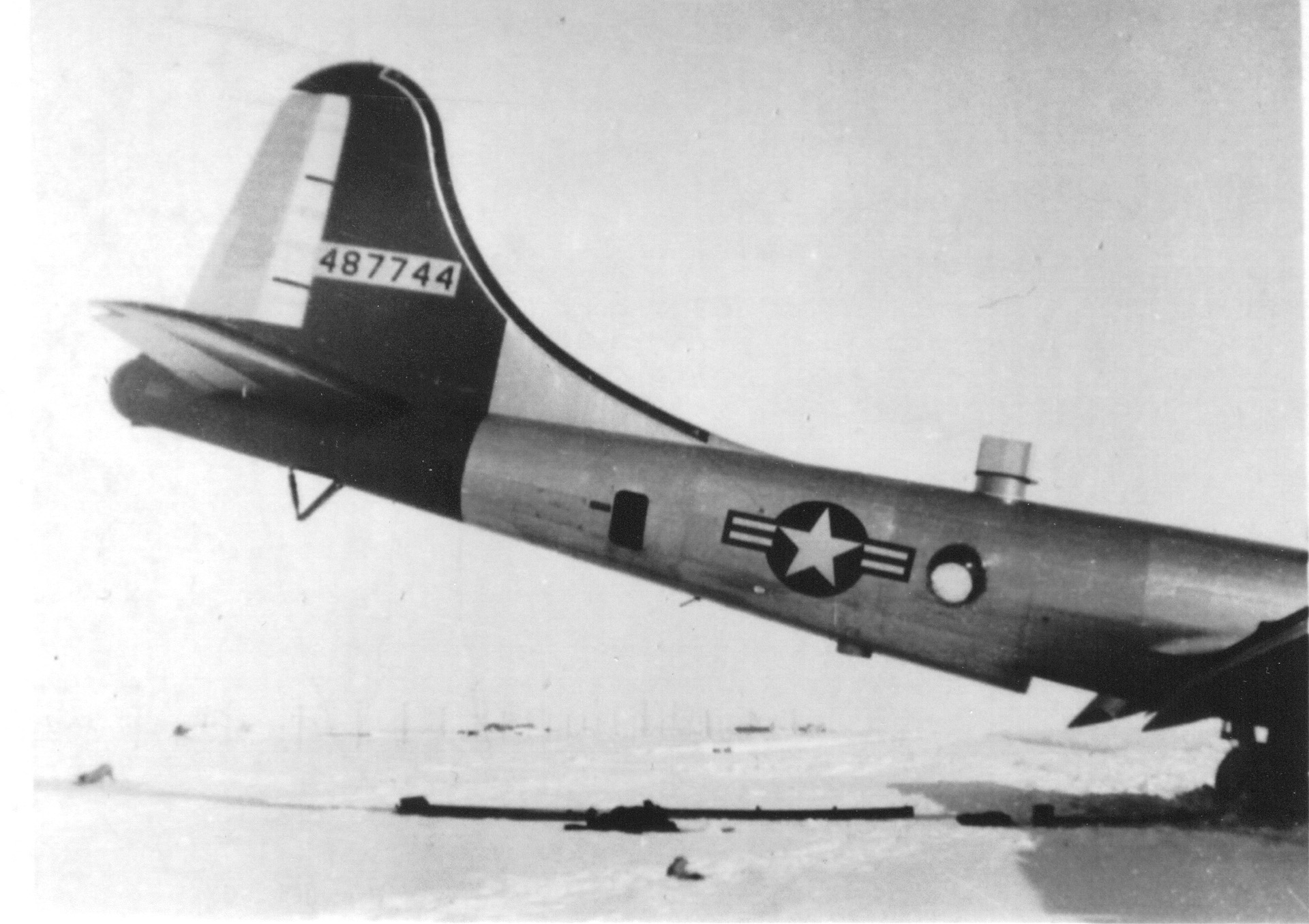
The B-29 fuselage, on the other hand, was hauled off the runway and abandoned.
Now 92 years old. Robert has one other strong memory of his two weeks at Moses Point: One of the service families they billeted with had a young daughter about 8 years of age. This little lady stuck by the recovery crew all day, every day. She virtually won herself a place on their team, and was even included in their group photo. (She’s also grinning from behind the first oil drum in that photo of the engines above.)
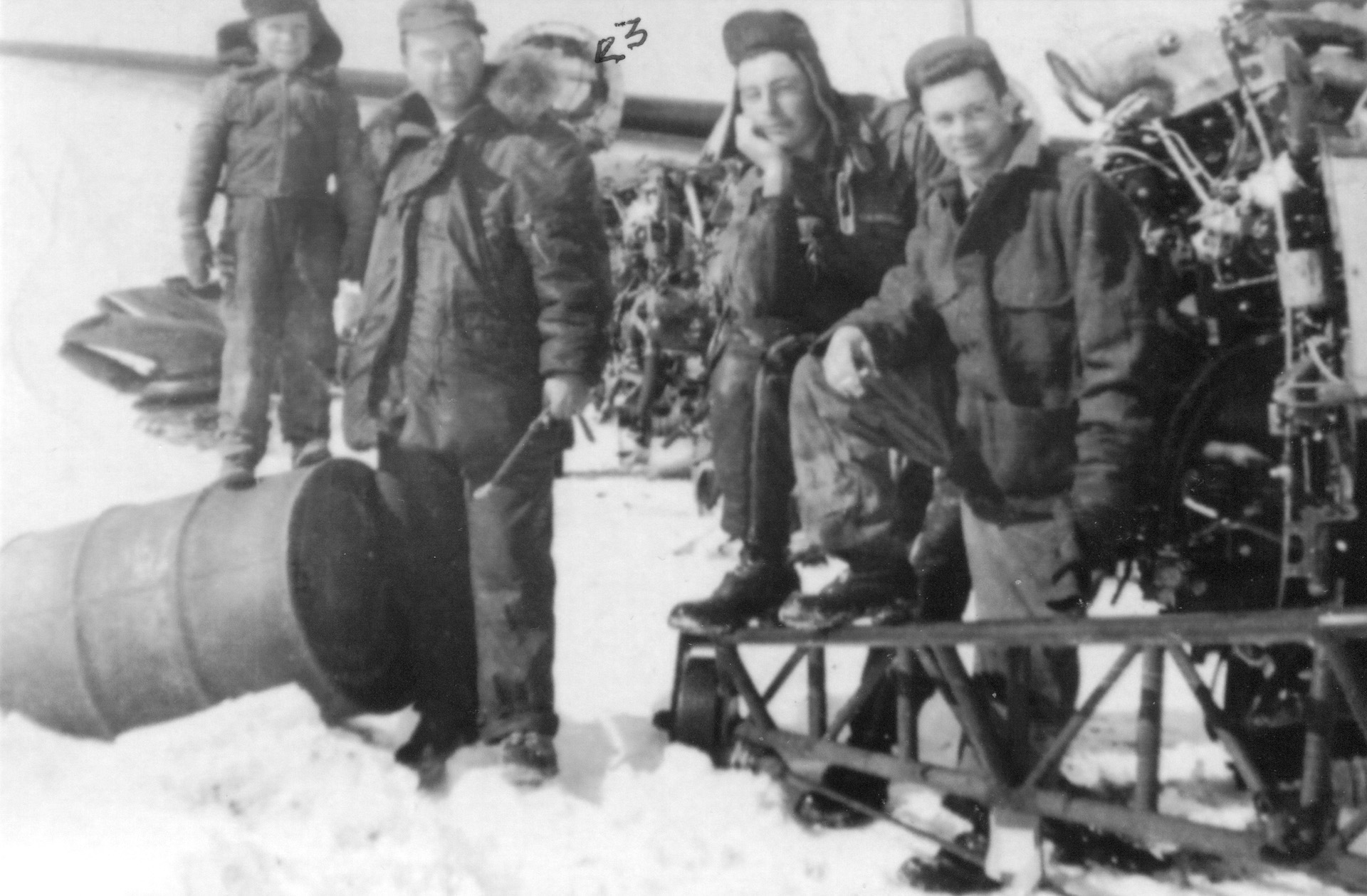
Robert would be delighted to know what happened to her so, if you’re about 80, spent some of your childhood at Moses Point and a this is all sounding kinda familiar, please Contact us.
General misadventure
After his initial adventure, the rest of Robert’s tour was fairly uneventful. However, he still chuckles about the group of four high-ranking officers who took a helicopter – we think a Sikorsky H-5 – for a Saturday hunting trip on Mount Redoubt, 100 miles southwest of Anchorage.
The helicopter was certified to carry four so getting down there went okay but, in a classic error, the return flight included a couple of trophy animals as well. At least, it would have… The overloaded helo barely made it into the air before the wheels were caught in trees and it came crashing back to earth.

The unfortunate officers scrambled free and called for help. Once again, the 39th Aircraft Repair Squadron rose to the occasion, but not before the brass hats had spent an extremely cold night camped on the mountain!
Robert says the loss of the aircraft was quietly papered over. But he his fairly sure lesser ranks would have been court-martialled for a similar misadventure!

Moving to Mobile
After completing his service, Robert continued working in aircraft maintenance for the USAF, but as a civilian contractor at Brookley Air Force Base, Alabama (now Mobile Downtown Airport). Headquarters for the Mobile Air Materiel Area (MOAMA), Brookley provided depot-level maintenance for a variety of aircraft including Fairchild C-119 Flying Boxcars and Convair C-131 Samaritans.
From there, Robert moved to nearby Teledyne Continental Motors, where he worked from 1973 to 1995. He was initially hired to support the ill-starred Continental Tiara project, before being reassigned to the production of more successful lines.
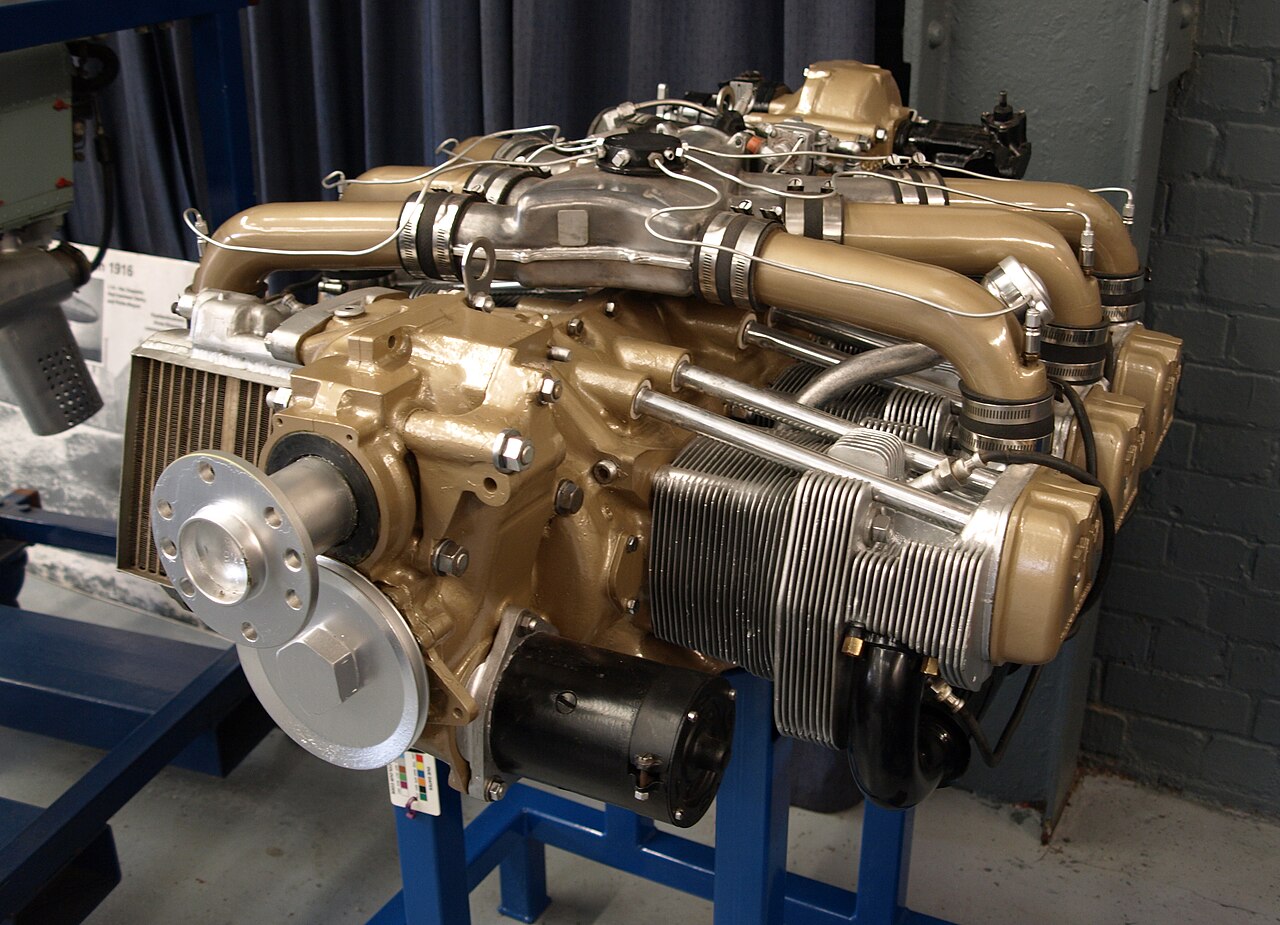
While working at Brookley, Robert bought and flew a rudderless Ercoupe/Aircoupe, but found flying too expensive on an aircraft mechanic’s wage. (Yes, even then!) He says the Ercoupe was interesting and fun to fly, but the lack of rudder awareness meant he wasn’t really qualified to fly anything else. A generous offer by Navy pilots to let him land a Grumman S2 Tracker they were testing ended up with a “sideways” landing and a cracked nose wheel…
Ultimately, he returned to his first love – motorbikes.

Sweet Home, Tennessee
Robert reckons he put 170,000 miles (273,588km) onto the three bikes he owned after he retired in 1995. He stopped riding and sold his last bike at age 90.
Now (2024) aged 92 years, Robert Liggett is back in his native Tennessee and still more than happy to talk about his life’s adventures.
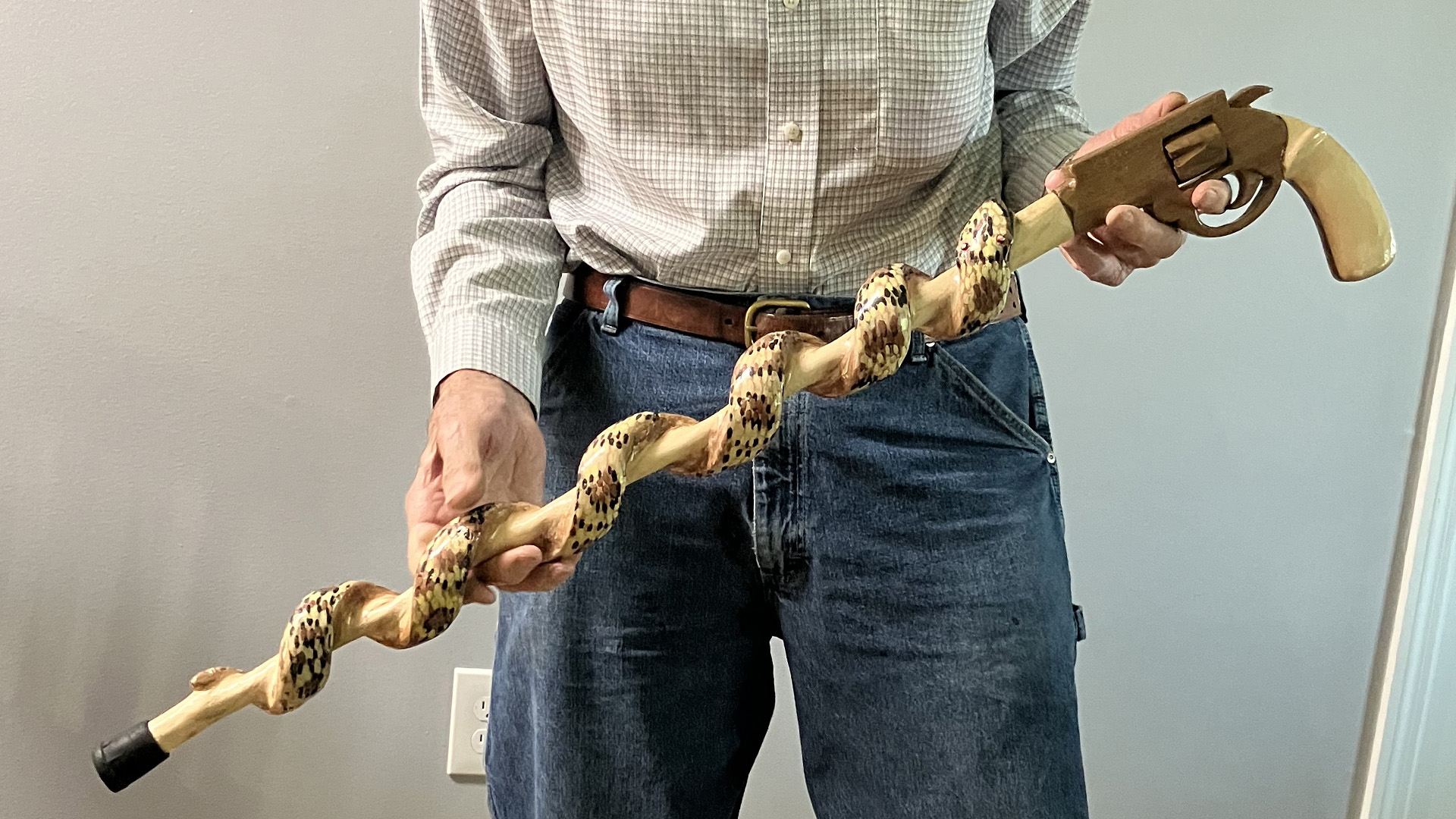
He keeps himself busy with a number of hobbies – including carving decorated walking sticks. His favourite theme is rendering natural vines into twisting snakes.
I am very grateful to Robert for sharing his time and memories, and his family for their help with our correspondence.

 airscape Magazine
Great story – good to have you back.
AK stories always make me think of the poor airman at Elmendorf in the post Vietnam era. It’s 2am and he’s connected up the ‘sucker’ to a B-707 transport (C-137) to empty the toilets’ waste tank of the ‘effluvium’ in the tank. The aircraft is running late and the pilot in command, a Major, is pacing up and down and shouting at the E-1 (Airman Basic) who is doing his best in the freezing conditions to hurry up or he’ll make his life miserable.
Eventually the E-1 turns to the Major and says, “Major, you can shout and threaten all you like, but what punishment can you possibly inflict on me? I’m the lowest rank in the Air Force, it’s 2am in Alaska, the temperature is 20 below and I’m shovelling shit!”
Hi Bob. Thanks for the comment. I’m not sure if that’s a true story or just a cautionary tale, but I thought about that stuff a lot when I was researching and writing ‘A Real Lady’. It would just be an unfathomable level of cold, and you can bet it wasn’t all headed hangars and workplace safety back in the 1950s!
I remember finding out that when you get that far north, the season that follows winter isn’t Spring, it’s called ‘Breakup’ – as in the rivers start flowing again. Makes me cold just thinking about it!
I ask my dad if he ever realised the possible danger he was in while he was stationed in Alaska. He said, not really he was having too much fun. Despite the cold.
Who’d a thought? That’s awesome!
Brilliantly written. I am so happy to have found Airscape and the article A Real Lady which led me here.
My dad was always talking about aeroplanes and his time in the USAF while I was growing up. I always love hearing his stories. It’s great to hear history first hand and wonderful that you are preserving it. Keep up the good work.
It has been a privilege. Thank you La Dona.
Hi, Mike here, retired aircraft mechanic. Looking at the first picture, I had to zoom in…. 42-65281 is a familiar tail number. In 1986 I was helping rivet the nose back together at Travis AFB, I was a Reserve C-141 Crew Chief back then.
Hi Mike. Nice ‘brush with fame’ there… -65281 was sure one of the lucky ones.